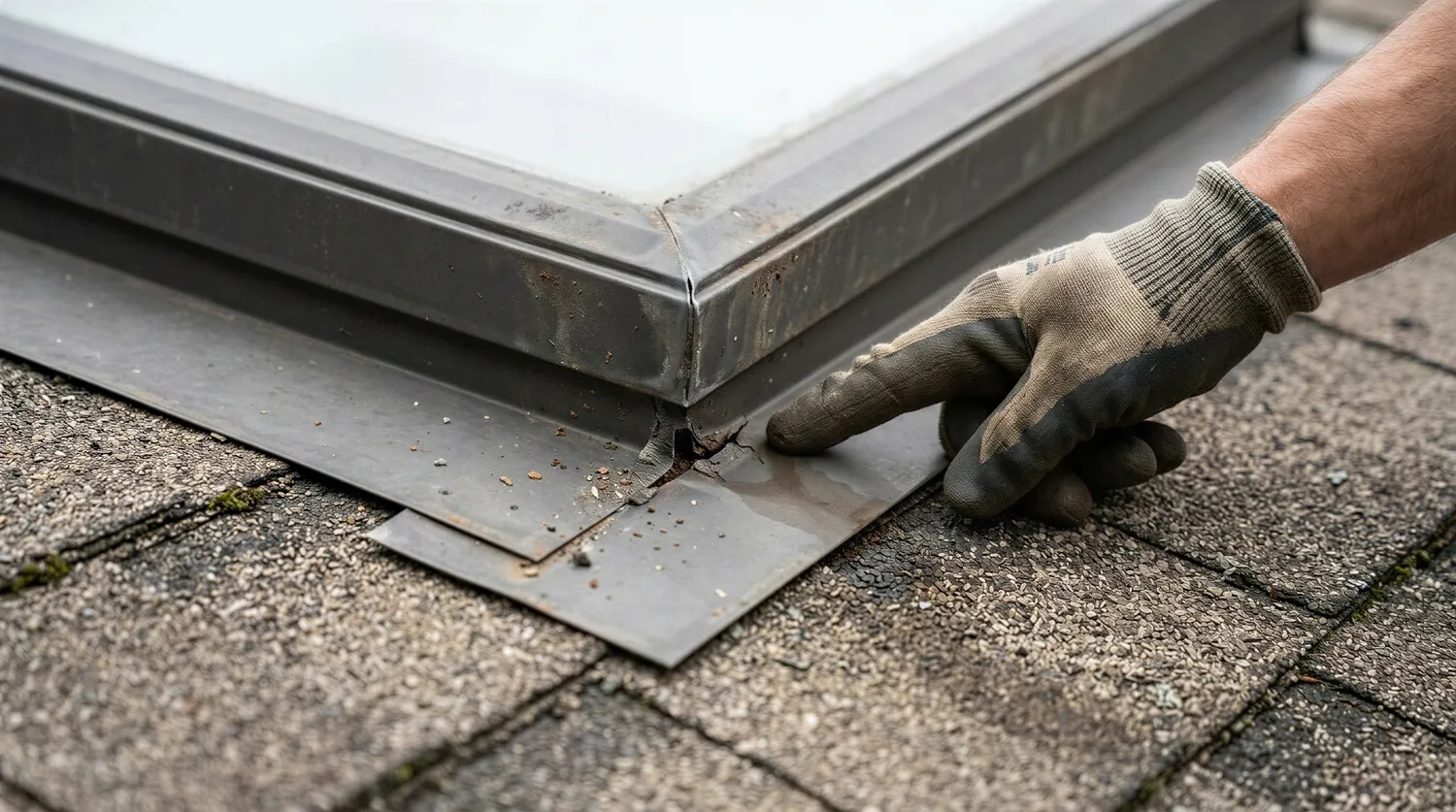
Roof flashing is thin sheet metal (usually galvanized steel, aluminum, or copper) installed at every place where the roof surface is interrupted: where it meets a wall or chimney, where two slopes form a valley, around vent pipes and skylights, and along the edges. Its job is to catch water at those joints and send it back out onto the roof surface instead of into the house.
Shingles and metal panels are good at shedding water across a flat, uninterrupted plane. Flashing handles everything else. And because “everything else” is where water concentrates, changes direction, and meets materials that move differently from each other, flashing is where the majority of roof leaks begin. Ask any roofer where they look first when a customer reports a leak, and the answer is almost never “the middle of the roof.”
The main types of roof flashing
Step flashing
Small L-shaped pieces of metal, typically 5″ x 5″ x 7″, installed one per shingle course wherever a roof slope runs alongside a wall (a “sidewall”). Each piece overlaps the one below like the shingles themselves. One leg lies on the roof under the shingle; the other stands up against the wall behind the siding or counter-flashing.
Headwall (apron) flashing
A single continuous strip where the top of a roof slope meets a vertical wall. The upper leg goes behind the wall covering; the lower leg lies over the shingles.
Counter-flashing
A second layer of metal that covers the top edge of step or base flashing, usually cut into a mortar joint on a chimney or tucked behind siding. It protects the joint where the base flashing meets the wall.
Chimney flashing
A combination: step flashing on the sides, apron flashing on the downhill face, a back pan or cricket (a small peaked diverter) on the uphill side, and counter-flashing let into the masonry. Chimneys are the single most common leak location on a residential roof because they involve four different flashing conditions on one penetration.
Valley flashing
Where two roof slopes meet, water from both sides funnels into the valley. Open valleys use a wide strip of metal (often W-shaped with a center rib); closed valleys rely on ice-and-water membrane under woven or cut shingles. Both are flashing systems.
Drip edge
An L-shaped metal strip along the eaves and rakes. It keeps water from wicking back under the roof edge into the fascia and decking, and directs runoff into the gutter. Missing or improperly lapped drip edge is a common cause of rotted fascia boards.
Kick-out flashing
A small angled piece at the bottom of a sidewall, where the roof eave meets a wall. It kicks water out into the gutter instead of letting it run down behind the siding. This one piece, roughly the size of your hand, prevents some of the most expensive hidden damage on a house: rot inside the wall directly below a roof-to-wall joint.
Pipe boot (vent flashing)
A metal or rubber collar around plumbing vents. The rubber gasket on inexpensive boots cracks in the sun after 8 to 12 years, well before the shingles wear out, and is one of the most common small-leak sources we find.
Skylight and vent flashing
Manufactured flashing kits for skylights, and metal bases for attic exhaust vents. Both rely on correct shingle-lapping to work.
Why most leaks start at the flashing
1. Water concentrates there
A valley collects runoff from two slopes. A chimney dams water on its uphill side. A sidewall receives every drop that hits the wall above it. These points see far more water per square inch than the open roof.
2. Different materials, different movement
Brick, wood, siding, and shingles all expand, contract, and settle at different rates. The flashing joint between them is under constant stress. This is why sealant alone never works long-term: it dries, cracks, and pulls away within a few seasons. Properly lapped metal sheds water without relying on sealant.
3. Corrosion
Galvanized flashing eventually rusts, especially at cut edges and where two dissimilar metals touch. Aluminum reacts with wet mortar and pressure-treated lumber. Copper is the longest-lived but is rarely used with asphalt shingles for cost reasons.
4. Reuse during reroofing
The most common flashing failure we see on 10- to 15-year-old roofs is old flashing that was left in place during a reroof. It looked serviceable at the time, but it had already lived one roof’s lifetime. Flashing should be replaced with the roof; it is a small fraction of the job and it is where the next leak will come from.
5. It is skipped or shortcut
Kick-out flashing is the classic example. It is required by code, yet it is missing on a large share of homes because it is fiddly to integrate with siding. The result is a slow leak down the inside of the wall that may not show up for years. Under the 2024 International Residential Code, Section R903.2, flashing is required at all wall and roof intersections, wherever the roof changes slope or direction, around roof openings and penetrations, and a kick-out flashing is required where an eave meets a sidewall.
6. Sealant is doing the work instead of metal
Tar or caulk smeared over a flashing joint is a sign that the flashing was not installed correctly to begin with. Sealant is a maintenance item that lasts a few years; metal properly lapped lasts as long as the roof.
How flashing is supposed to be installed
The principle is simple: water runs downhill, so every piece of metal must overlap the piece below it. Upper pieces go over lower pieces. The vertical leg goes behind whatever is on the wall. Metal must be corrosion-resistant. For asphalt shingle roofs on a sidewall, the code requires step or continuous flashing at least 4 inches up the wall and 4 inches onto the roof, though roofers typically use 5″ x 5″ pieces or larger. The U.S. Department of Energy’s Building America program has a detailed guide to roof-to-wall flashing with diagrams, and Green Building Advisor’s All About Roof Flashing is a good deeper read if you want to understand what your roofer should be doing.
On flat and low-slope roofs the same principles apply but the materials differ: membrane flashings, termination bars, and metal counter-flashing at parapets and curbs. These are the failure points on flat roofs too. See our post on avoiding flat roof repairs for more.
Signs your flashing is failing
From inside:
- Water stains on a ceiling or wall near a chimney, skylight, or where a lower roof meets an upper wall
- Peeling paint or soft drywall on an exterior wall below a roofline
- Rust stains on the underside of roof decking in the attic, near a penetration
From outside (from the ground or a ladder, not on the roof):
- Visible rust on metal at the chimney or walls
- Flashing pulled away from a wall or chimney, leaving a gap
- Cracked or missing mortar where counter-flashing enters the brick
- Tar or caulk smeared along any flashing joint
- Cracked rubber on a pipe boot
- Siding or fascia rot at the bottom of a roof-to-wall joint (a missing kick-out flashing almost every time)
- Granules or debris piling up in a valley, which traps water against the valley metal
If you see any of these, the leak may not have started yet, but it will.
Can flashing be repaired without replacing the roof?
Usually, yes. Pipe boots, chimney counter-flashing, and kick-out flashings can be replaced on an existing roof by lifting the surrounding shingles. Step flashing is harder because each piece is woven into the shingle courses; on an older roof, the shingles may crack when lifted, so a small section sometimes has to be reshingled. Valley flashing replacement generally means removing the shingles on both sides of the valley.
Flashing repairs are one of the most common jobs our roof repair team does, and they are far less expensive than the interior water damage they prevent. If the roof itself is near the end of its life, though, patching the flashing is usually a bridge, not a fix. Our post How Do I Decide Whether to Replace or Repair? walks through that decision.
Questions to ask any roofer about flashing
- Will you replace all existing flashing, or reuse any of it?
- What metal are you using, and what gauge?
- Will you install kick-out flashing at every sidewall eave?
- How will you integrate the flashing with my siding? (If siding needs to come off and go back on, our siding services team handles that on the same project.)
- Will you cut new counter-flashing into the chimney mortar or surface-mount it with sealant?
- Will you install new drip edge at eaves and rakes, and in what order relative to the underlayment?
A roofer who answers these clearly is a roofer who understands where roofs leak.
The bottom line
Flashing is a small part of a roof by area and by cost, and it is responsible for most leaks. It fails because of water concentration, material movement, corrosion, reuse, and shortcuts. Replacing it with the roof, installing kick-outs, and choosing lapped metal over sealant are the three things that make the biggest difference.
JJ Roofing Construction Enterprises repairs and replaces flashing on shingle, metal, and flat roofs throughout Chicago and the western suburbs, including Elmhurst, Wheaton, and Naperville. If you have a stain near a chimney or wall and want to know where it is coming from, contact us for an inspection.